
General Introduction
What if Geometry Could Explain the Quantum World?
Modern physics has long been divided between two great frameworks: general relativity, which explains the large-scale universe through gravity and curved spacetime, and quantum mechanics, which governs particles and atoms through probability and uncertainty. Both have been remarkably successful — but they also remain deeply disconnected. For over a century, scientists have searched for a deeper understanding that might bring these two worlds together.
Trembling Spacetime Relativity Theory (TSRT) is an independent research effort that takes a fresh approach to this challenge. Instead of using probability to describe particles, TSRT explores whether geometry alone — in the form of curved, fluctuating spacetime — can give rise to the patterns and behaviors we usually associate with quantum physics.
In this model, particles follow stable paths, or geodesics, through a dynamically trembling spacetime. The theory suggests that certain effects we’ve long attributed to “quantum rules” — such as interference, entanglement, or energy levels in atoms — might actually emerge from deeper geometric processes. These effects are calculated using classical tools, but with new assumptions about the nature of spacetime itself.
The work is still unfolding. So far, it has been used to explain a variety of physical phenomena — from the energy levels of hydrogen and muonic hydrogen atoms, to blackbody radiation, and the patterns seen in the famous double-slit experiment — without relying on quantum postulates like wavefunctions or uncertainty principles.
This doesn't mean the theory replaces quantum mechanics — rather, it suggests there might be a different way to arrive at the same physical results, and possibly more. It opens the door to rethinking how the deepest laws of nature might operate, and how gravity, particles, and fields may be connected at their core.
The same causal trembling framework has also been extended to cosmology, where it explains the emergence of four-dimensional spacetime, the origin of cosmic expansion, and the large-scale evolution of the universe without invoking inflation or a cosmological constant.
The research is being shared openly through CERN’s Zenodo archive, and more developments are expected in the near future.
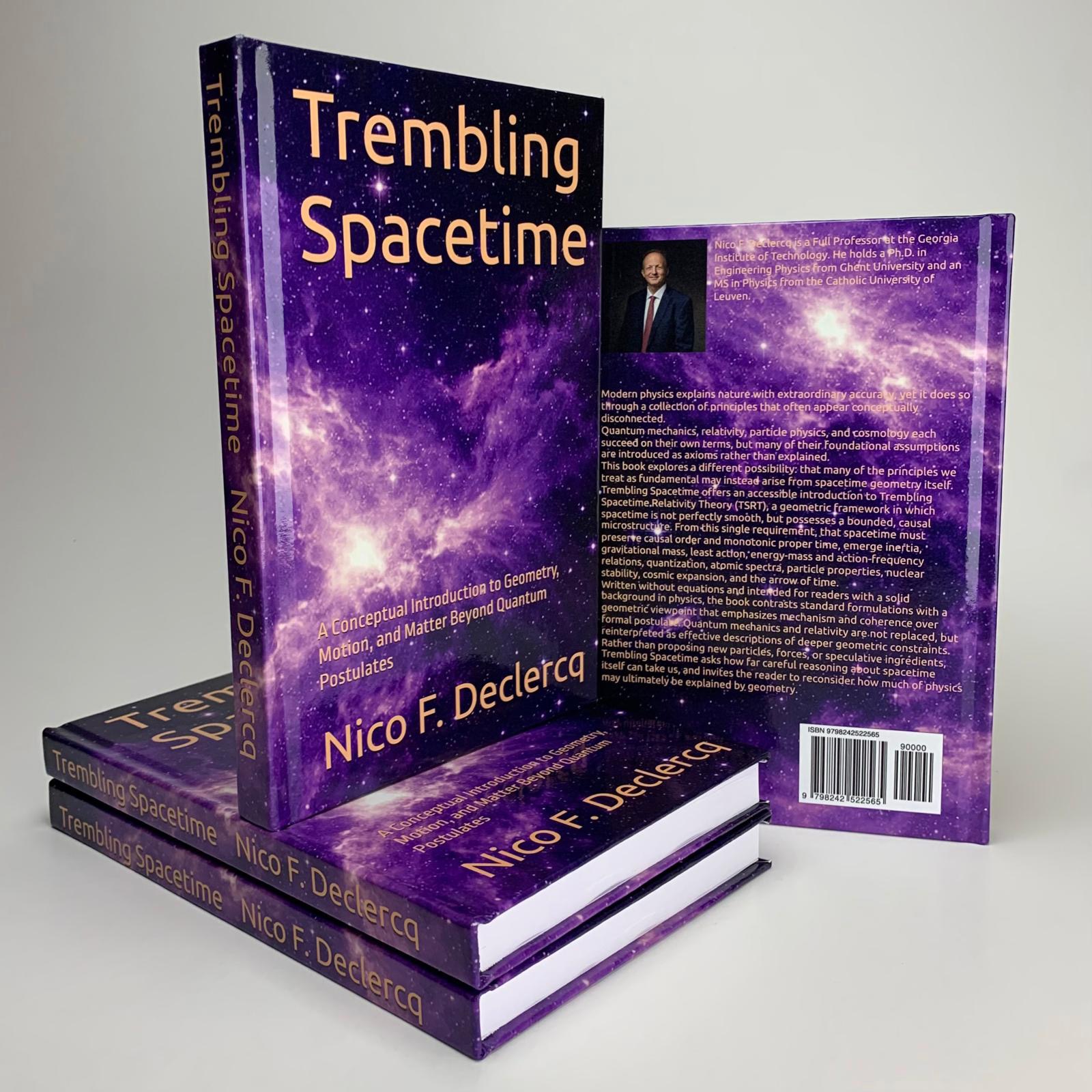
This work is introduced through a book that does not contain equations:
Trembling Spacetime: A Conceptual Introduction to Geometry, Motion, and Matter Beyond Quantum Postulates. 2026 ISBN: 9798242522565 (hardcover); ISBN: 9798242520431 (softcover). The authoritative version is archived at Zenodo: 10.5281/zenodo.18144832
See also Tracie Troha, George W. Woodruff School of Mechanical Engineering, December 16, 2025.